Sell My Amazing Spider-Man #1 in Southern California — Get Offer Now
If you’ve got a copy of The Amazing Spider-Man #1 sitting in a box, a collection, or a closet somewhere in Southern California, I want to buy it. My name is Gabe from EZ Comic Buyer, and I’ve been buying and grading comics for years. I know what this book is worth, I know what to look for, and I’ll give you a fair cash offer on the spot. Call me at (951) 515-9604 — I answer personally. If you want to learn more about what makes your copy valuable before you sell, keep reading.
Why Amazing Spider-Man #1 Is One of the Most Important Comics Ever Printed
The Amazing Spider-Man #1 hit newsstands in March 1963, and it changed everything. Published by Marvel Comics, this wasn’t just Spider-Man’s first solo book after his debut in Amazing Fantasy #15 — it introduced J. Jonah Jameson, the Chameleon, and established the tone for one of the longest-running series in comic book history. If you own a copy, you’re holding a piece of comic book history that collectors have been chasing for over 60 years.

What’s Actually in Amazing Spider-Man #1
Most people don’t realize this issue is split into two completely independent stories. The first story, scripted by Stan Lee with art by Steve Ditko, opens with a brief retelling of Spider-Man’s origin from Amazing Fantasy #15 — the radioactive spider bite, Uncle Ben’s death, all of it. Then it gets into the real story. Aunt May is struggling to pay bills after Ben’s death. Peter offers to quit school and get a job, but May insists he stay in school so he can become a scientist like Uncle Ben always hoped.
Next, Peter decides to keep performing as Spider-Man for money. He amazes an audience, goes to collect his earnings, and the booking agent has to write the check out to “Spider-Man” because Peter won’t reveal his identity. Then — and this is peak teenage Peter Parker — he actually takes the check to a bank thinking they’ll cash it. They don’t. That’s the kind of writing that made this character different from every other superhero on the shelf.
This is also where J. Jonah Jameson enters the picture. He’s already written a scathing editorial in the Daily Bugle calling Spider-Man a menace and a lawless vigilante. When Spider-Man saves Jameson’s own son John from a crashing spacecraft — literally reattaching a guidance unit mid-flight — Jameson responds by publicly accusing Spider-Man of sabotaging the craft in the first place. The authorities declare Spider-Man a wanted criminal. Even Aunt May believes he should be imprisoned. The issue ends with Peter questioning his entire future as Spider-Man.
The Chameleon and the Fantastic Four
The second story introduces the Chameleon as the first true villain Spider-Man faces in his own book. Peter, desperate for money, decides to join the Fantastic Four — assuming they’ll pay him as a member. He travels to the Baxter Building, breaks in through a window, gets trapped in a plexiglass cage, breaks free with his super strength, and then finds out the Fantastic Four are a nonprofit organization. He leaves in frustration.
Meanwhile, the Chameleon steals missile defense plans from a military installation while disguised as Spider-Man. He even broadcasts a frequency that only Spider-Man’s spider sense can detect to lure him to the scene — a power that basically disappeared from later issues. Eventually, Spider-Man tracks the Chameleon to the waterfront, intercepts the handoff to a Soviet submarine, tears the door off the Chameleon’s helicopter, and forces him back to the police. In the end, the Chameleon tries one last trick — disguising himself as a cop — but Spider-Man’s spider sense sees through it.
One detail that collectors and historians love: Peter Parker’s name is misprinted as “Peter Palmer” throughout the entire issue. It’s a production error from 1963, and it’s one of those things that adds character to the book.
What Makes Your Copy of Amazing Spider-Man #1 Valuable
When I evaluate a copy of ASM #1, I’m not just looking at a number on a slab. I’m looking at the actual condition of the book — what’s there, what’s not, and how it presents. Whether your copy is raw or graded, here’s what affects the value.
Cover Presentation and Eye Appeal
The first thing I look at is how the cover presents. On a Silver Age book like ASM #1, cover presentation is everything. Are the colors bright? Does the red on Spider-Man’s suit pop? Is the yellow sharp? A book with strong eye appeal — where the colors are still vibrant and the cover reflects light well — is worth significantly more than a dull, faded copy even at the same technical grade.
Beyond color, cover reflectivity matters. When you hold the book up to light at different angles, gloss becomes visible — and so does damage that only shows at certain angles. In fact, some books look great straight on but have hidden bends and creases that only appear when you tilt them in the light. That’s why grading in person is so important.
Spine, Staples, and Bindery
The spine tells a huge story on any Silver Age book. Color-breaking spine ticks, spine stress marks, spine roll, and splits are all factors that directly affect grade. In particular, color-breaking spine ticks are a big problem — they can cap a book regardless of how nice everything else looks.
If the spine has been folded back multiple times, you’ll see heavy ticks and crinkling that’s very difficult to press out on a book this old. As a result, pressing has real limitations on books from the 1960s. When creases have been there for 60 years, the paper fibers have settled. You can flatten them temporarily, but they often revert.
Additionally, staples matter more than most sellers realize. Rust, loose alignment, and staple tears where the staple meets the paper all affect grade. Rusted staples will eventually cause a migration stain onto the paper — a brown mark that spreads over time. On ASM #1, finding tight, non-rusted, straight staples in a Silver Age book from 1963 is a very good sign.
Page Quality and Interior Condition
Page quality is something a lot of sellers overlook, but it directly affects grade and value. As comics age, the paper darkens — from white to off-white, then cream or tan, and eventually brownish. On a 1963 book like ASM #1, off-white to cream pages are normal. If the pages are still in the off-white range, that’s strong for a book this old.
To measure this accurately, you need an OWL card — if you’re not using one, you’re not grading properly. You lay the card against the pages in different areas of the book because page quality can vary from front to back. Typically, the interior pages near the covers show more tanning than the center.
On top of that, the book needs to be complete — no coupons cut out (kids loved cutting out those Sea-Monkeys ads), no missing pages, no interior tears or stains. Water damage, foxing, and staining all affect grade. The centerfold also needs to be checked to make sure the staples are attached and tight.
Marvel Chipping and the Mis-Wrap
Something specific to Silver Age Marvel books like ASM #1 is what’s called Marvel chipping — small chips along the edges of the cover that happened during the printing and trimming process. This was normal for that time period, so grading companies expect to see it on books from this era and don’t take a massive amount off for it. Similarly, a slight mis-wrap — where the cover isn’t perfectly aligned to the interior pages — is common on books from the early ’60s. As a result, depending on severity, it’s usually not a huge defect.
Color Touch-Ups and Restoration
On a high-value Silver Age key like ASM #1, restoration detection is critical. If a book has had a color touch-up — where someone painted over a defect to make it look better — it drastically affects value. The trick is that the naked eye doesn’t always see color touch-ups. Anyone who tells you they can spot every touch-up with the naked eye is not being honest.
Instead, you need a black light. Run it over the cover in a dark room and any color touch-up will glow. It’s a cheap, effective way to check, and it’s something I do on every significant book I evaluate. If there’s been restoration — color touch, tape on the spine, trimmed edges, reattached pages — the book gets a different designation from grading companies like CGC or CBCS, and the value changes significantly.
Grading and Value: What Your Amazing Spider-Man #1 Might Be Worth
ASM #1 holds value across every grade. That’s what makes it special — even a heavily worn copy is worth real money because of what it is. Here’s a realistic breakdown of where copies typically land:
A copy in Poor to Fair condition (0.5–1.5) with heavy wear, possibly incomplete, detached cover, or major defects is still worth $2,000–$5,000. Meanwhile, copies in Good to Very Good (2.0–4.5) with significant wear, creasing, spine issues, and tanning typically fall in the $5,000–$15,000 range.
Fine to Very Fine copies (5.0–7.5) with moderate wear but solid eye appeal and decent page quality can bring $15,000–$40,000. Near Mint copies (8.0+) are rare and start at $50,000, with high-grade slabbed copies going well into six figures.
These are general ranges based on recent sales data from Heritage Auctions and GoCollect — the actual value of your specific copy depends on exactly what I find when I examine it. That’s why I evaluate in person. Call me at (951) 515-9604 and I’ll come to you anywhere in Southern California.
How to Handle Your Copy Before Selling
If you think you have a copy of ASM #1, here’s what to do — and what NOT to do. First, never try to clean it yourself. Avoid erasing pencil marks, taping tears, or pressing it under something heavy. Any of these things can cause more damage or be classified as restoration, which hurts value. For example, some people try to clean the white borders of a cover with an eraser and end up pulling ink off the book. It’s an old trick that works in skilled hands, but if you don’t know exactly what you’re doing, you can cause permanent damage.
If it’s raw (not in a CGC or CBCS slab), store it flat on a backing board in a bag. Also, handle it with clean, dry hands — or white cotton gloves if you have them. Gloves are especially important for Golden Age and early Silver Age books because the acid on your fingers soaks into the older paper. In addition, keep it out of direct sunlight and away from moisture. If it’s already slabbed, just keep it safe and bring it as-is.
Why Sell to EZ Comic Buyer Instead of Grading It Yourself
You could send your ASM #1 to CGC or CBCS yourself, wait weeks for it to come back, and then try to sell it on eBay where you’ll pay fees, deal with shipping risk on a book worth thousands, and hope the buyer doesn’t file a dispute. Alternatively, you could just call me.
At EZ Comic Buyer, I come to you anywhere in Southern California — Orange County, Los Angeles, Riverside, San Bernardino, San Diego, or Ventura County. I grade your book in person, explain exactly what I’m seeing and why, and make you a fair cash offer based on current market data. There’s no shipping risk, no grading fees, and no waiting. You walk away with cash or a check the same day.
I buy ASM #1 in any condition — slabbed or raw, Near Mint or missing the back cover. Even if it’s been sitting in a garage in Riverside for 40 years and it’s tanned and creased and the staples are rusted, it still has real value and I want to see it. Call (951) 515-9604 or fill out the form on our contact page.
Frequently Asked Questions About Selling Amazing Spider-Man #1
How do you determine what my Amazing Spider-Man #1 is worth?
I evaluate the book in person using the same criteria professional grading companies use — cover presentation, spine condition, staple integrity, page quality, and any defects like creases, tears, staining, or restoration. I check page quality with an OWL card and use a black light to detect any color touch-ups. My offer is based on the book’s actual condition and current market sales data.
Do I need to get my comic graded before selling?
No. I grade it myself when I come to you. Sending a book to CGC or CBCS costs money, takes weeks, and there’s always shipping risk with a high-value book. I save you all of that. If your book is already slabbed, I’ll factor that into my offer.
My copy is in rough shape — is it still worth selling?
Yes. ASM #1 holds value in every condition. Even a copy with a detached cover, heavy creasing, rusted staples, and brittle pages is worth thousands of dollars. Don’t assume your copy isn’t valuable because it looks rough. Call me and let me see it.

What if I’m not sure it’s a real copy and not a reprint?
I can tell immediately when I see it in person. There are specific indicators — paper quality, printing characteristics, interior ads, and trade dress — that distinguish an original 1963 printing from later reprints and facsimiles. If you’re unsure, just bring it or send me a photo and I’ll let you know.
How does pressing affect the value of my comic?
Pressing can improve the appearance of certain defects like bends and light creases, potentially raising the grade. However, pressing has real limitations on Silver Age books from the 1960s — creases that have been there for 60 years often revert after pressing. Furthermore, pressing is not restoration as long as no material is added or removed. I can advise you on whether pressing would benefit your specific copy.
What other Spider-Man comics do you buy?
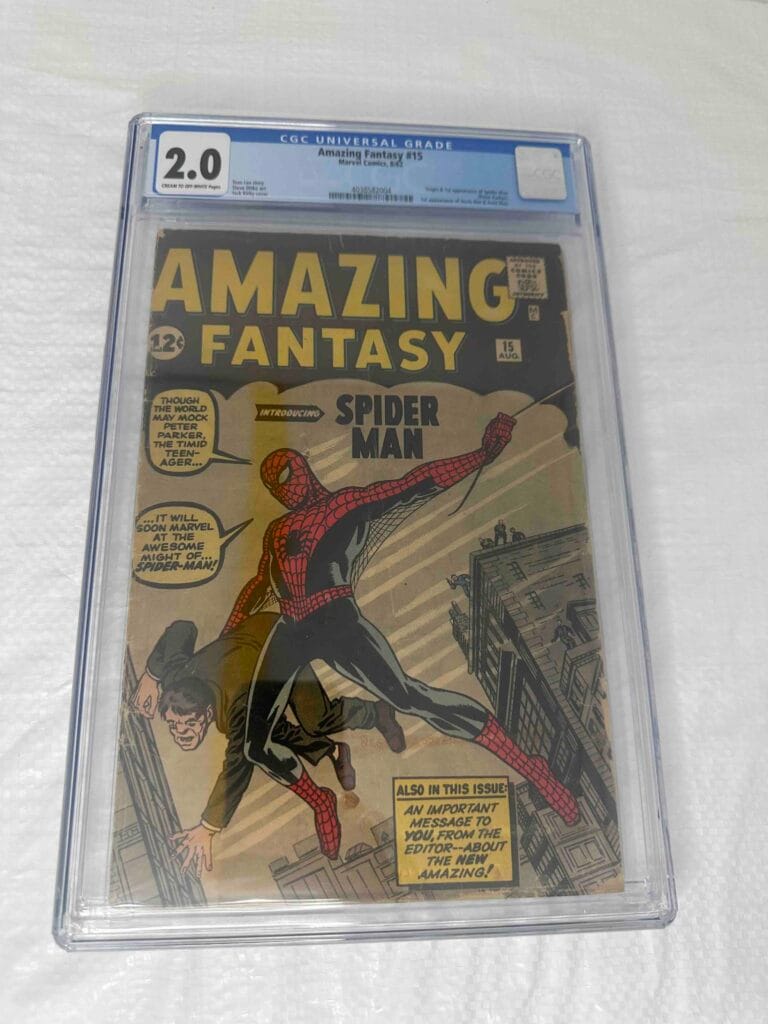
Everything. Amazing Fantasy #15, the entire ASM run from #1 to the latest issue, spin-offs like Spectacular Spider-Man, Web of Spider-Man, Ultimate Spider-Man, Spider-Man 2099 — plus variants, crossovers, and bulk collections. Check out our Top 10 Comics page for more high-value books we buy.
Where do you pick up comics?
Anywhere in Southern California — Orange County, Los Angeles County, Riverside County, San Bernardino County, San Diego County, and Ventura County. I come to your home, office, or storage unit. Call (951) 515-9604 and we’ll schedule a time that works for you.
How fast can I sell my comic?
Usually same day. Call me, describe what you have, and I’ll come out — often within hours. I pay cash or check on the spot after I evaluate the book in person.
Sell Your Amazing Spider-Man #1 Today
Whether your copy of The Amazing Spider-Man #1 is a high-grade slab or a well-loved reader copy from 1963, EZ Comic Buyer wants to see it. I come to you anywhere in Southern California, evaluate the book in person using real grading tools and standards, and pay you cash on the spot. There are no fees, no shipping hassles, and no waiting.
Gabe — EZ Comic Buyer
(951) 515-9604
Calicomicbuyer@gmail.com
Serving all of Southern California: Orange County, Los Angeles, Riverside, San Bernardino, San Diego, and Ventura County.
Contact us here · Read our reviews