Search this comic and you will find $147,500, from February 2012. Before you anchor on it, you should know what that copy was: a double cover. Green Lantern 1 value traces back to it.

When a comic came off the press with a second cover still attached underneath the first, the inner one was protected from eighty years of handling and the outer one took all the wear. Collectors prize them, and they pay for them.
A double cover is a factory mistake, and collectors pay a premium for it, which makes it the wrong yardstick for your copy. The saner benchmark is a standard CGC 9.0, which reportedly brought $29,875 in November 2009.
Two records, both stale
| Copy | Result | When |
|---|---|---|
| CGC 9.0, double cover | $147,500 (reported) | reportedly February 2012 |
| CGC 9.0, standard | $29,875 (reported) | reportedly November 2009 |
I want to be straight about the quality of this evidence. Neither figure is one I could open a primary source for, so both stay labeled as reported. And both are old, one is fourteen years old, the other seventeen.
The Golden Age market has moved a great deal in that time, and books that were quiet in 2009 have been repriced substantially since. Both of the numbers on this page are old enough that I would treat them as floors rather than guides.
They may not stay stale forever, either: a CGC 7.0 copy came up in ComicLink’s Winter Featured Auction, which opened February 13, 2026, no result I can document yet, but a modern sale on a copy like that is exactly what would reset these marks.
That is an unsatisfying answer and I would rather give it than a confident wrong one. What it means practically is that if you own a copy, the useful step is a current valuation rather than a search result.
Which Green Lantern this is
The mix-up I have to sort out most often on this title is which Green Lantern the caller means.
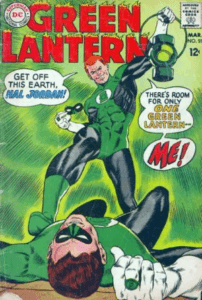
This is Alan Scott, from 1941, a railroad engineer with a magic lantern and a ring, no connection to space, no Corps, no aliens. The Green Lantern most people picture is Hal Jordan, who arrived in 1959 in Showcase #22 and is a completely different character with a completely different origin.
DC has also published several later comics called Green Lantern #1, in 1960, 1990, 2005 and since. If you have a comic with that title and a number one on it, the year in the publication details is what settles which book you are holding, and the difference is measured in orders of magnitude.
One more thing worth knowing: this is Alan Scott’s solo title, not his debut. He first appeared in All-American Comics #16, which is the more valuable and considerably scarcer book.
What a double cover is, and how to check
Since the headline sale on this book was a double cover, it is worth knowing how to spot one, because owners often do not realize what they have.
At the bindery, a comic occasionally received two covers instead of one. The second sits directly beneath the first, complete and printed, and because it spent eighty years shielded from light and handling it is almost always in far better shape than the outer one.
To check, look at the very edge of the front cover where it meets the first page. A double cover shows as two distinct cover-stock layers rather than one, and the inner one will usually be noticeably brighter at the edge. Do not pry, bend or separate anything to find out, if you think there is a second layer, that is a question for a grader, not for your fingers.
The premium is real and can be substantial, which is why the record on this issue sits so far above the ordinary high-grade result. It is also why I would not want anyone quoting the $147,500 at you for a normal copy.
The ladder, top to bottom
What follows for Green Lantern #1 is all 53 documented results, each one dated:
| Grade | Result | Where and when |
|---|---|---|
| CGC 9.0 | $32,200 | Heritage Auctions, Oct 10, 2002 |
| CGC 9.0 | $35,650 | Heritage Auctions, Oct 12, 2002 |
| CGC 9.0 | $29,875 | Heritage Auctions, Nov 19, 2009 |
| CGC 9.0 | $44,812 | Heritage Auctions, Aug 1, 2013 |
| CGC 7.5 | $13,225 | Heritage Auctions, Dec 7, 2002 |
| CGC 7.5 | $13,623 | Heritage Auctions, Nov 15, 2007 |
| CGC 7.5 | $9,560 | Heritage Auctions, Jul 27, 2012 |
| CGC 7.0 | $10,638 | Heritage Auctions, Aug 4, 2002 |
| CGC 7.0 | $12,075 | Heritage Auctions, Feb 9, 2005 |
| CGC 7.0 | $10,235 | Heritage Auctions, Oct 15, 2005 |
| CGC 7.0 | $14,340 | Heritage Auctions, Feb 28, 2008 |
| CGC 6.5 | $7,170 | Heritage Auctions, May 12, 2006 |
| CGC 6.5 | $7,469 | Heritage Auctions, May 22, 2008 |
| CGC 6.5 | $8,365 | Heritage Auctions, Nov 13, 2008 |
| CGC 6.5 | $8,962 | Heritage Auctions, Feb 26, 2009 |
| CGC 6.5 | $7,170 | Heritage Auctions, Feb 25, 2010 |
| CGC 6.5 | $10,158 | Heritage Auctions, Aug 27, 2015 |
| CGC 6.5 | $18,600 | Heritage Auctions, Sep 30, 2025 |
| CGC 6.0 | $7,475 | Heritage Auctions, Jul 4, 2002 |
| CGC 6.0 | $6,325 | Heritage Auctions, Feb 7, 2004 |
| CGC 6.0 | $7,768 | Heritage Auctions, May 5, 2011 |
| CGC 6.0 | $27,500 | eBay, Dec 29, 2022 |
| CGC 6.0 | $29,500 | eBay, Nov 23, 2024 |
| CGC 5.5 | $6,900 | Heritage Auctions, May 19, 2005 |
| CGC 5.5 | $5,378 | Heritage Auctions, Nov 15, 2012 |
| CGC 5.5 | $5,975 | Heritage Auctions, May 28, 2015 |
| CGC 5.5 | $15,600 | Heritage Auctions, Jan 26, 2024 |
| CGC 5.5 | $16,470 | Heritage Auctions, Mar 16, 2026 |
| CGC 5.0 | $5,975 | Heritage Auctions, May 16, 2013 |
| CGC 5.0 | $8,400 | Heritage Auctions, Nov 19, 2020 |
| CGC 5.0 | $21,600 | Heritage Auctions, Jul 17, 2023 |
| CGC 5.0 | $15,600 | Heritage Auctions, Jul 25, 2025 |
| CGC 5.0 | $20,740 | Heritage Auctions, May 14, 2026 |
| CGC 4.5 | $4,481 | Heritage Auctions, Nov 20, 2014 |
| CGC 4.0 | $4,140 | Heritage Auctions, Jul 15, 2003 |
| CGC 4.0 | $5,138 | Heritage Auctions, May 13, 2016 |
| CGC 4.0 | $7,800 | Heritage Auctions, Nov 19, 2020 |
| CGC 4.0 | $13,644 | eBay, May 25, 2026 |
| CGC 3.0 | $3,107 | Heritage Auctions, May 12, 2006 |
| CGC 3.0 | $3,884 | Heritage Auctions, Nov 20, 2014 |
| CGC 3.0 | $5,520 | Heritage Auctions, Nov 21, 2019 |
| CGC 3.0 | $9,000 | Heritage Auctions, Nov 14, 2022 |
| CGC 3.0 | $13,200 | Heritage Auctions, Jun 11, 2025 |
| CGC 3.0 | $10,675 | Heritage Auctions, Mar 16, 2026 |
| CGC 2.5 | $3,360 | Heritage Auctions, Nov 23, 2019 |
| CGC 2.0 | $4,966 | eBay, Nov 10, 2021 |
| CGC 0.5 | $777 | Heritage Auctions, May 21, 2006 |
| Raw | $4,025 | Heritage Auctions, Mar 16, 2002 |
| Raw | $4,370 | Heritage Auctions, Jun 2, 2002 |
| Raw (FR) | $1,840 | Heritage Auctions, May 2, 2004 |
| Raw (PR) | $1,076 | Heritage Auctions, Mar 2, 2014 |
| Raw (PR) | $1,792 | Heritage Auctions, Mar 11, 2018 |
| Raw | $2,400 | eBay, Dec 19, 2022 |
Sale records assembled from Heritage Auctions results and eBay completed sales via PriceCharting’s public feed, cross-checked against CGC’s published auction reporting. Heritage lots are verifiable in the catalog at comics.ha.com.
CGC 6.5 has 7 results to its name: $7,170 (2006), $7,469 (2008), $8,365 (2008), $8,962 (2009), $7,170 (2010), $10,158 (2015), $18,600 (2025). Front of the lane, end of the list: $18,600, 2025.
Selling a Green Lantern #1
- Check the year first. 1941 is the one this page is about. Any other year is a different comic entirely.
- Look for a double cover before you assume you do not have one. It is worth checking whether the front cover has another beneath it, because the premium is real.
- Get a current read. The public record here is fourteen to seventeen years old, which makes it close to useless as a quote and useful only as a floor.
- Do not clean or press. On a 1941 comic there is no home treatment that helps and several that permanently hurt.
Send photographs and I will tell you which Green Lantern you have and what a current copy in that condition is realistically worth, rather than quoting you a search result from 2012.
Have a copy?
Send three photos: front, back, and the small print. That is all I need to tell you where your copy really sits.
I read every request myself.
Related
- All-American Comics #16, Alan Scott’s first appearance and the more valuable book.
- Flash Comics #1, the other All-American key of the era.
- The 100 most valuable Golden Age comics, and what each one really sold for.
Cover images on this page are shown small, for identification, with the publisher credited in the caption. If you are a rights holder and want an image removed, contact me and it comes down.