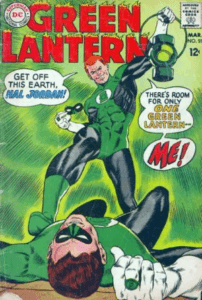
In 1940, Timely put the Human Torch and the Sub-Mariner in the same story and had them fight each other. Before that, superheroes fought criminals, spies and monsters. They did not fight other superheroes. Marvel Mystery Comics 9 value follows from it.

Everything Marvel has built since out of heroes in conflict, every crossover, every event, every argument that turns into a punch, starts in these pages, under a Schomburg cover.
Two sales five months apart
| Grade | Result | Where and when |
|---|---|---|
| CGC 4.0 | $64,600 | ComicLink, August 2023 |
| CGC 4.5 | $57,005 | ComicLink, March 2023 |
| CGC 9.4 | $107,000 (reported) | reportedly 2009 |
Two mid-grade sales five months apart is a better gift to a seller than one spectacular one. These are the grades real copies occupy, they are recent, and they are close enough together to describe a working range rather than a single event.
There is an oddity worth naming: the 4.0 brought more than the 4.5. Half a grade lower, seven and a half thousand dollars higher, five months later. On any single pair that is noise, page quality, eye appeal, who was bidding, and I mention it only so you do not treat a half grade as decisive on this book.
The guide numbers are not sales
You will find this issue listed at around $5,100 in 2.0, $10,200 in 4.0 and $15,300 in 6.0. Those are the Overstreet 2022 guide values for GD 2.0, VG 4.0 and FN 6.0, opinions, not sales, and they are worth understanding correctly.
A guide value is somebody’s opinion written down. A sale is what a person actually paid. Compare the guide’s $10,200 for a 4.0 with the $64,600 an actual 4.0 brought at auction in 2023, the real result was more than six times the listed value.
That is not a criticism of the guide, which serves a different purpose and covers thousands of issues it cannot track individually. It is a warning about using one to price a key. I have written about how guides go stale and why they lag hardest exactly where the money is.
I will show you which of the numbers I quote are sales and which are opinions, every time. On this page the first two lines are sales and everything else is labeled.
Why the early Marvel Mystery run matters
This was Timely’s flagship anthology and the title that kept the company alive in its first years. It is worth knowing which issues carry weight, because they surface together.
The Human Torch and Sub-Mariner rivalry ran across several issues rather than one, and collectors chase the sequence. Issue 8 sets it up, issue 9 is the fight, and issue 10 is the finale, all three trade at real money and all three are frequently in the same box.
Beyond the rivalry, the early numbers are simply scarce. Marvel Comics #1 is the famous one, but issues 2, 3 and 4 are difficult books in their own right, and #3 carries the first Schomburg cover for the company.
The mistake I would guard against is treating anything past the number one as a run to be priced by the inch. On early Timely that is how serious money gets left behind.
What the record actually shows
33 verified Marvel Mystery Comics #9 sales follow, top grades first, house and day attached:
| Grade | Result | Where and when |
|---|---|---|
| CGC 9.4 | $107,550 | Heritage Auctions, May 21, 2009 |
| CGC 8.0 | $40,250 | Heritage Auctions, Mar 6, 2003 |
| CGC 8.0 | $40,250 | Heritage Auctions, Mar 6, 2003 |
| CGC 8.0 | $42,550 | Heritage Auctions, Feb 7, 2004 |
| CGC 7.5 | $35,850 | Heritage Auctions, Feb 22, 2012 |
| CGC 7.5 | $35,850 | Heritage Auctions, Feb 22, 2012 |
| CGC 7.5 | $26,290 | Heritage Auctions, Nov 15, 2012 |
| CGC 7.5 | $26,290 | Heritage Auctions, Nov 15, 2012 |
| CGC 6.5 | $10,062 | Heritage Auctions, Dec 6, 2002 |
| CGC 6.5 | $8,769 | Heritage Auctions, Nov 22, 2003 |
| CGC 6.0 | $22,705 | Heritage Auctions, May 20, 2010 |
| CGC 6.0 | $66,000 | Heritage Auctions, Sep 30, 2025 |
| CGC 5.5 | $6,920 | Heritage Auctions, Jul 15, 2003 |
| CGC 5.5 | $6,920 | Heritage Auctions, Jul 15, 2003 |
| CGC 5.0 | $20,315 | Heritage Auctions, Aug 7, 2008 |
| CGC 5.0 | $20,315 | Heritage Auctions, Aug 7, 2008 |
| CGC 3.5 | $38,400 | Heritage Auctions, Jul 17, 2023 |
| CGC 3.0 | $28,800 | Heritage Auctions, Jan 26, 2024 |
| CGC 3.0 | $28,800 | Heritage Auctions, Oct 10, 2024 |
| CGC 3.0 | $26,840 | Heritage Auctions, Mar 16, 2026 |
| CGC 2.5 | $7,768 | Heritage Auctions, Feb 24, 2011 |
| CGC 2.5 | $7,768 | Heritage Auctions, Feb 24, 2011 |
| CGC 2.5 | $5,228 | Heritage Auctions, Nov 15, 2011 |
| CGC 2.5 | $5,228 | Heritage Auctions, Nov 15, 2011 |
| CGC 2.5 | $5,975 | Heritage Auctions, Aug 7, 2014 |
| CGC 2.5 | $5,975 | Heritage Auctions, Aug 7, 2014 |
| CGC 2.0 | $15,000 | Heritage Auctions, Jul 25, 2025 |
| Raw (PR) | $1,265 | Heritage Auctions, Oct 30, 2005 |
| Raw (PR) | $1,265 | Heritage Auctions, Oct 30, 2005 |
| Raw (PR) | $2,390 | Heritage Auctions, Jun 29, 2008 |
| Raw (PR) | $2,390 | Heritage Auctions, Jun 29, 2008 |
| Raw (FR) | $2,390 | Heritage Auctions, May 2, 2010 |
| Raw (FR) | $2,390 | Heritage Auctions, May 2, 2010 |
Sale records assembled from Heritage Auctions results and eBay completed sales via PriceCharting’s public feed, cross-checked against CGC’s published auction reporting. Heritage lots are verifiable in the catalog at comics.ha.com.
At CGC 2.5 alone there are 6 receipts: $7,768 (2011), $7,768 (2011), $5,228 (2011), $5,228 (2011), $5,975 (2014), $5,975 (2014). $5,975 in 2014 sits under the $7,768 peak from 2011.
Selling a Marvel Mystery Comics #9
- Ignore guide values on this issue. The documented auction results run many times higher and are the only figures worth quoting.
- Do not assume a mid-grade copy is a minor one. Both documented sales are in the fours and both cleared fifty thousand dollars.
- Check the run. Early Marvel Mystery issues carry value across the board, and #9 rarely surfaces alone.
- No repairs, no pressing, no tape. Whatever a treatment appears to fix, the grader records it and the label carries it for the life of the book.
Have a copy?
Send three photos: front, back, and the small print. That is all I need to tell you where your copy really sits.
I read every request myself.
Related
- Marvel Comics #1, where both characters start.
- Sub-Mariner Comics #1, Namor’s own title.
- Why guide values are not sale prices.
- The 100 most valuable Golden Age comics, and what each one really sold for.
Cover images on this page are shown small, for identification, with the publisher credited in the caption. If you are a rights holder and want an image removed, contact me and it comes down.