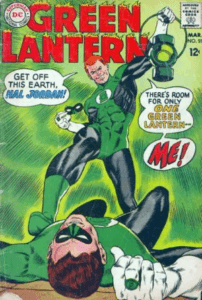
There is no Whiz Comics #1. Not a rare one, not an expensive one, no such comic to find. The first issue Fawcett ever sold is numbered 2, which collectors write as Whiz #2 (#1). Whiz Comics 2 value keys off that fact.

I have had people apologize for only having the second issue. They were holding the first one. It is the most common thing I explain about any Fawcett book, and on a comic that has sold for over a quarter of a million dollars it is worth getting right.
Why the first issue says #2
The short version is a copyright dodge, and it was standard practice at the time.
Before putting a new title on the newsstand, a publisher would produce an ashcan: a handful of copies, often a new cover stapled over another comic’s interior, printed in tiny numbers and never sold. The point was to register the title and secure the trademark before a competitor claimed it.
Fawcett made ashcans under two names, Flash Comics and Thrill Comics, with the hero called Captain Thunder. Both were problems: another publisher already used Flash Comics, and Captain Thunder had its own conflicts. Fawcett switched to Whiz Comics, renamed the character Captain Marvel, and carried the numbering forward. CGC tells the same ashcan story in its auction coverage.
The result is a first issue with a 2 on the cover, which makes the cover number the least useful thing on this comic. Check the publisher, the date, and the indicia, the small print inside the front cover.
The character who outsold Superman, and the lawsuit that ended him
Captain Marvel is not a footnote hero in an old comic. Through the 1940s he was, by most accounts, the best-selling superhero in America, outselling Superman at the peak. A boy named Billy Batson says a word and becomes the hero, an idea children responded to enormously.
That success is what got him killed. DC sued Fawcett, arguing Captain Marvel was too close to Superman. The litigation ran more than a decade, and in 1953 Fawcett settled and stopped publishing the character. He was gone from newsstands for twenty years, and when DC acquired the rights it could not use the name on a cover, a competitor having claimed it. That is why he now goes by Shazam.
For a seller that history matters. Fawcett’s run was cut short, the books went out of print and stayed out, with no reprint program keeping copies circulating the way DC and Marvel had. What survives, survived on its own.
What the old record copy was, and how the record fell
For over a decade the number to beat was $281,001 for a CGC 9.0, ComicConnect, December 2012, a copy my research puts at the Library of Congress. Then in June 2024 a CGC 7.0, two grades lower with no institutional story, brought $288,000 at Heritage Auctions and the record fell.
Institutional provenance does a pedigree’s job, for the same reason: it explains the condition. A comic that sat in a national library rather than a child’s bedroom has a storage history a bidder believes, and on eighty-six-year-old newsprint that is worth money.
So treat the library copy’s number as proof demand exists at the top, not as a starting point for your copy. The 2024 number is the better evidence for a seller: an ordinary copy with nothing going for it beat the record anyway.
The six sales worth knowing
| Grade | Result | Where and when |
|---|---|---|
| CGC 9.0 (ex-Library of Congress) | $281,001 | ComicConnect, December 2012 |
| CGC 7.0 | $288,000 | Heritage Auctions, June 2024 |
| CGC 6.0 | $176,000 | December 2011 |
| CGC 5.5 | $188,600 | ComicConnect, March 2023 |
| CGC 3.5 | $120,000 | Heritage Auctions, January 2023 |
| CGC 3.0 | $78,000 | Heritage Auctions, June 2021 |
The 7.0 line is the one to point at: a collector-grade copy that in June 2024 beat what the library copy brought in 2012. A record falling to a copy two grades lower is the market moving, measured rather than guessed. Read the bottom of the table too, where a 3.0 brought $78,000 and a 3.5 brought $120,000.
The 6.0 line says what it always said. A mid-grade comic, honest wear, nothing hidden, and it brought $176,000 as far back as 2011. Demand here runs deep rather than concentrating at the top: people want the book, not a perfect example of it.
Now the caveat. The 2011 and 2012 results are roughly fourteen years old, and the June 2024 sale settled what that meant: a 7.0 clearing the old 9.0 record shows those early figures were floors. One modern sale is a benchmark, not a curve, so a decent copy deserves a current read rather than arithmetic on somebody else’s.
The ashcans themselves, and why you will not find one
Since the ashcans are the reason the numbering is strange, people reasonably ask whether the ashcans are worth anything. They are, enormously, and you are not going to find one.
These were internal legal documents in comic-book clothing, produced to be filed rather than sold and mostly destroyed once done. Survivors number in single figures and surface roughly never, so a suspected one is almost certainly a later reprint or a cover reproduction.
The practical point is the opposite of how it sounds: the ashcans do not compete with your comic. Whiz Comics #2 is the first issue anybody could buy and the one the market treats as the key.
The rest of the Fawcett run is worth checking too
If a Whiz Comics #2 turned up in a collection, it almost never turned up alone. Whoever bought it in 1940 was a Captain Marvel reader, and Captain Marvel readers bought Captain Marvel comics for years afterward.
- Whiz Comics #25, the first Captain Marvel Jr., a genuinely valuable book in its own right and the one I would look for second.
- Captain Marvel Adventures #1, a 1941 title with a Jack Kirby-drawn cover, and a key in its own section of the market.
- The Marvel Family #1, 1945, and the first appearance of Black Adam, whose profile rose considerably once the character reached film.
- The rest of the Whiz run, ordinary issues, but early Fawcett in any condition has buyers, and a run stored together usually graded together.
This is the most common way real money gets left in a box: somebody identifies the one famous comic, sells it, and treats the rest as filler. On a Fawcett collection that rest is frequently where half the value sits.
Why so few copies survived
Two things worked against this comic, and together they explain why even beaten copies are worth serious money.
The first is ordinary. A 1940 magazine for children on cheap pulp paper, thrown out, which is true of the period generally and why the whole Golden Age is scarce.
The second is particular to Fawcett. When the lawsuit ended the character in 1953 he stopped being anything: no reprints, no back-issue demand, no reason to keep early issues through the fifties and sixties. By the time the hobby organized around Golden Age comics, twenty years had passed with nobody preserving Fawcett books.
That gap matters. The comics that survive in decent shape from 1940 are usually the ones somebody had a reason to keep. For most of the period when it counted, nobody had a reason to keep this one.
Which brings me back to the numbers. Six documented sales in thirteen years, all landing high, even beaten copies: a 3.0 at $78,000 in 2021, a 3.5 at $120,000 eighteen months later. That happens because so few copies survived that the market takes what it can get.
The receipts, all of them
Every Whiz Comics #2 sale I can verify, 17 rows over 23 years, not one estimated:
| Grade | Result | Where and when |
|---|---|---|
| CGC 7.5 | $13,200 | Heritage Auctions, Sep 9, 2021 |
| CGC 7.0 | $288,000 | Heritage Auctions, Jul 1, 2024 |
| CGC 7.0 | $288,000 | Heritage Auctions, Jul 25, 2025 |
| CGC 6.5 | $1,610 | Heritage Auctions, Nov 21, 2003 |
| CGC 6.0 | $173,275 | Heritage Auctions, May 10, 2018 |
| CGC 6.0 | $150,666 | Heritage Auctions, Nov 21, 2019 |
| CGC 5.5 | $20,700 | Heritage Auctions, Apr 3, 2004 |
| CGC 5.5 | $21,275 | Heritage Auctions, Jan 20, 2006 |
| CGC 3.5 Conserved | $1,434 | Heritage Auctions, May 8, 2016 |
| CGC 3.0 | $7,170 | Heritage Auctions, Nov 13, 2008 |
| CGC 3.0 | $52,580 | Heritage Auctions, May 28, 2015 |
| CGC 2.5 | $9,560 | Heritage Auctions, Feb 25, 2010 |
| CGC 2.5 | $48,000 | Heritage Auctions, Dec 13, 2024 |
| CGC 2.0 | $3,360 | Heritage Auctions, Jun 5, 2024 |
| CGC 0.5 | $3,107 | Heritage Auctions, Feb 22, 2014 |
| Raw | $2,977 | eBay, Apr 17, 2022 |
| Raw | $4,000 | eBay, Jul 30, 2023 |
Sale records assembled from Heritage Auctions results and eBay completed sales via PriceCharting’s public feed, cross-checked against CGC’s published auction reporting. Heritage lots are verifiable in the catalog at comics.ha.com.
Selling a Whiz Comics #2
- Confirm the issue from the indicia, not the cover number. Fawcett, 1940, and the small print inside the front. This is the one book on my list where the cover number is actively misleading.
- Leave it completely alone. Eighty-six-year-old newsprint shows every intervention, and graders are looking for exactly the marks that well-meaning tidying leaves behind.
- Check for completeness. The centerfold especially. On a book this old, an incomplete copy is a different object with a different market.
- Get a current valuation, not a 2012 one. The June 2024 sale showed how far past the old records the market had moved; anyone quoting you confidently off the 2011 and 2012 sales is quoting you off history. What an appraisal actually involves covers what should happen instead.
- Take the auction route seriously here. A strong copy of this issue is exactly the kind of book where the bidders who produced those results belong in the room, and grading it first is what lets them bid with confidence.
Photographs cost nothing, and on this title the first thing to establish is whether you hold the first issue or a later one. I will answer that before anything else.
Have a copy?
Send three photos: front, back, and the small print. That is all I need to tell you where your copy really sits.
I read every request myself.
More on the books that get misnumbered
- Flash Comics #1, the DC title whose name Fawcett had to give up.
- How to work out what any old comic is worth, starting from the indicia.
- The 100 most valuable Golden Age comics, and what each one really sold for.
Cover images on this page are shown small, for identification, with the publisher credited in the caption. If you are a rights holder and want an image removed, contact me and it comes down.