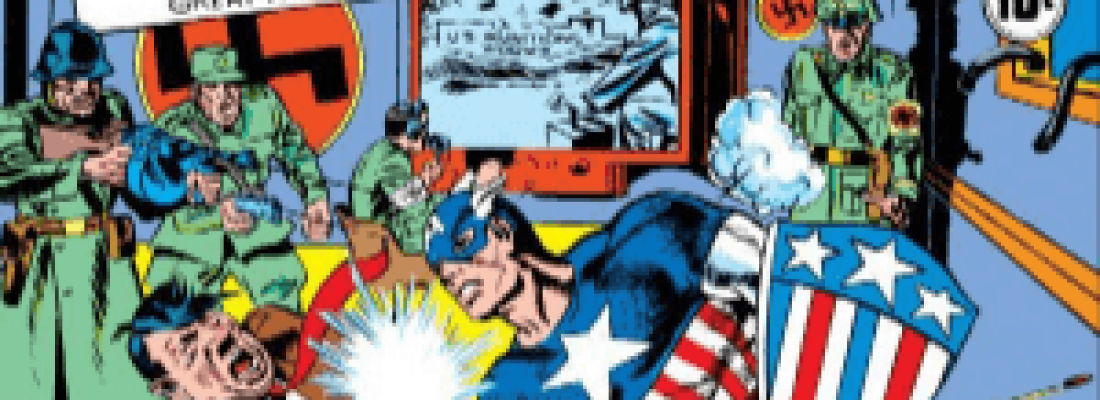
The punch is on the front cover, not buried inside the book. Captain America drives a right hand into Adolf Hitler’s jaw while a room of Nazi officers watches, and anyone walking past a newsstand could see it. That issue went on sale in December 1940 carrying a March 1941 cover date. The United States would not enter the war for another full year. That cover is most of the reason Captain America Comics #1 value sits where it does.
That timing is the whole story of Captain America Comics #1. Joe Simon and Jack Kirby put a flag-wearing hero on a cover swinging at a sitting head of state while American opinion about the war was still genuinely split, and they did it as a commercial gamble at a small publisher called Timely. By Simon’s own later telling, the office took hate mail and threatening phone calls over it, and New York’s mayor reportedly called to say the city would keep an eye on them. I pass that along as the reported history it is, not as something I can document.

Eighty-five years later this is one of a handful of comic books that can change a family’s finances, and it is also one of the most reprinted covers in the business, so the copy in your grandfather’s closet is probably not the 1941 printing. This page is about telling those apart. Every dollar figure below either carries its date and its auction house, or it is labeled reported so you know how much weight to give it. I do not print numbers I cannot stand behind.
If you think you have one right now, stop handling it and text a photo of the cover and the small print inside to (951) 515-9604.
What is actually inside it
Three debuts sit in one 68-page pamphlet that sold for a dime:
- Captain America, in his origin story, Steve Rogers and the super-soldier serum included.
- Bucky Barnes, the sidekick who would matter enormously to Marvel decades later when he came back as the Winter Soldier.
- The Red Skull, in the original version of the character. Marvel later reworked the Skull into the Johann Schmidt that readers and moviegoers know, but the name and the mask start here.
Add the Simon and Kirby credit, which collectors treat as a value factor in its own right, and add the cover, arguably the most reproduced single image in American comics. Marvel Comics #1 from 1939 is the book that starts the company, and after that one, this is the most valuable Timely comic there is. It is the more famous of the two by a wide margin, because the Hitler punch escaped comics entirely and became American iconography.
Here is what the top of the market has actually paid, with the receipts attached:
| Documented high | $3,120,000 for the CGC 9.4 San Francisco pedigree copy, the Tom Reilly collection, April 2022, Heritage Auctions |
| The same copy, three years earlier | $915,000 in 2019. It tripled in three years. |
| Documented mid-grade | $339,760 for a CGC 7.0, March 2022, ComicConnect |
| Reported floor | About $20,000 for a copy in any condition, from an undated price guide |
Treat that floor as conservative rather than current. The same source still lists the 2019 sale as the book’s record, which tells you how far behind the market it is running.
Before anything else: is yours a reprint?

This is the long section on purpose, because it is the section that applies to almost every copy that surfaces. Marvel has put this cover back into print many times over: a Marvel Milestone Edition in the 1990s, modern facsimile editions, hardcover and trade collections of the Golden Age Captain America material, and merchandise ranging from posters and prints to t-shirts, mugs and framed cover art. The reprints are the copies that live in ordinary collections. Originals do not.
None of that is a scam. Marvel reprinted the book because people want the image. The trouble starts only when a reprint gets mistaken for the real thing, usually by someone clearing out a relative’s house who has no reason to know the difference. Here are the tells, in the order you can check them without touching much.
The paper
Newsprint from 1941 is not white. Interior pages run cream to tan to brown, the paper has visible texture and a slight roughness at the edges, and the ink has soaked into the fibers instead of sitting on the surface. Modern reprints are printed on bright, smooth, even paper, and the cover usually has a sheen the original never had. Hold the two side by side and nobody needs training to see it. Age can be faked to a degree, but the crispness of modern stock is hard to hide.
The price box and the trade dress
An original says 10 CENTS on the cover. Facsimile editions reproduce that box faithfully, which is why the price box alone can never clear a book, but the reprints from the 1990s and 2000s runs mostly do not bother hiding what they are. Look for a banner or logo strip across the top of the cover announcing a Milestone or facsimile edition, a modern Marvel corner box, or a modern cover price printed somewhere on the front. Then look for two things a 1941 comic physically cannot have: a barcode, and a direct-market diamond box in the corner. Neither existed in the forties. Either one ends the conversation.
The indicia
The indicia is the block of tiny legal print, usually on the first interior page, and it is where a reprint confesses. An original names Timely and a 1941 publication date. A reprint carries a modern copyright year, a modern Marvel corporate address, and very often the words “reprint” or “facsimile” outright. Whatever the cover claims, the indicia is the document. Photograph it. If you want to sanity-check a printing yourself, the Grand Comics Database catalogs every edition of this book for free, and a trade collection or omnibus will show up there as exactly what it is.
The object in your hands
A real one is a fragile 68-page pamphlet, stapled twice, oversized compared with a modern comic, and soft. It sags when you hold it by one edge. Corners are almost always rounded from age even on strong copies, and the spine is a genuine weak point. A hardcover, a squarebound book, a glossy comic that feels stiff, a poster or a framed print is not the 1941 comic no matter how convincing the artwork looks. If what you are holding feels sturdy, it is not this book.
One more caution: covers get married to other books, and reproduced covers get glued onto coverless copies. That is a restoration question, and it is why a book at this level ends up in front of a professional grader rather than settled by a phone call.
What a pedigree does to the price here
Three collection names keep appearing in this book’s record book, and they are not marketing. A pedigree is a documented original-owner collection, usually bought new off the stand by one person and stored untouched for decades, verified well enough that CGC prints the collection’s name on the grading label. That name follows the book forever, and it carries a premium an otherwise identical copy does not.
- San Francisco, the Tom Reilly collection, known for exceptional page quality. It owns the record above.
- Promise, the collection Heritage brought to market in the 2020s.
- Allentown, whose copy sits at the top of the CGC census for this book at 9.8.
Two reported sales show the size of that premium better than any explanation. A Promise Collection copy graded CGC 3.5 is reported to have brought $168,000 in June 2023 at Heritage. A CGC 5.5 is reported at $172,221 in August 2024. Both of those figures reach me secondhand rather than from a record I can pull up myself, so hold them loosely, but keep the years attached: a pedigree copy two full grades lower landed in the same neighborhood as an ordinary copy a year later. The label did roughly two grades of work.
For a seller that means one thing: if a grandparent bought comics new and kept them together, keep the box together and tell that story to whoever handles the sale. Documented provenance is worth real money here. Provenance you assert without evidence is worth nothing, so do not stretch it.
Reading the ladder
Captain America Comics #1 trades more often than almost anything else printed in 1941, and the sixty dated, attributed results below are the proof. On this book the ladder is evidence, not anecdote.
| Grade | Result | Where and when |
|---|---|---|
| CGC 9.4 | $3,120,000 | Heritage Auctions, Apr 8, 2022 |
| CGC 9.4 | $3,120,000 | Heritage Auctions, Apr 19, 2022 |
| CGC 9.2 | $810,000 | Heritage Auctions, Jun 22, 2023 |
| CGC 9.2 | $750,000 | Heritage Auctions, Apr 17, 2024 |
| CGC 9.0 | $96,686 | Heritage Auctions, Jan 19, 2006 |
| CGC 8.5 | $63,250 | Heritage Auctions, Oct 14, 2005 |
| CGC 8.5 | $95,600 | Heritage Auctions, May 21, 2009 |
| CGC 8.0 Restored | $78,200 | ComicConnect, Sep 23, 2022 |
| CGC 8.0 Restored | $72,000 | Heritage, Jan 9, 2025 |
| CGC 7.5 Conserved | $96,000 | Heritage Auctions, Nov 21, 2019 |
| CGC 7.5 Conserved | $168,000 | Heritage Auctions, Sep 14, 2023 |
| CGC 7.0 | $20,400 | Heritage Auctions, Jul 15, 2003 |
| CGC 7.0 | $89,625 | Heritage Auctions, Jul 27, 2012 |
| CGC 7.0 | $228,000 | Heritage Auctions, May 16, 2019 |
| CGC 7.0 | $186,000 | Heritage Auctions, Mar 5, 2020 |
| CGC 7.0 | $339,760 | ComicConnect, Mar 17, 2022 |
| CGC 7.0 | $312,000 | Heritage Auctions, May 26, 2022 |
| CGC 7.0 | $201,000 | ComicLink, Mar 1, 2023 |
| CGC 7.0 | $300,150 | ComicConnect, Mar 17, 2023 |
| CGC 7.0 | $266,813 | ComicConnect, Mar 21, 2025 |
| CGC 7.0 Restored | $132,000 | Heritage, Apr 3, 2025 |
| CGC 7.0 | $305,000 | Heritage Auctions, Feb 26, 2026 |
| CGC 6.5 Restored | $67,850 | ComicConnect, Mar 15, 2026 |
| CGC 6.0 | $15,008 | Heritage Auctions, Mar 6, 2003 |
| CGC 5.5 | $77,675 | Heritage Auctions, May 28, 2015 |
| CGC 5.5 | $156,000 | Heritage Auctions, Aug 1, 2019 |
| CGC 5.5 | $168,000 | Heritage, Nov 21, 2024 |
| CGC 5.5 | $174,000 | Heritage, Jun 26, 2025 |
| CGC 5.0 | $16,730 | Heritage Auctions, Nov 19, 2009 |
| CGC 5.0 | $180,000 | Heritage Auctions, Sep 8, 2022 |
| CGC 5.0 | $180,000 | Heritage Auctions, Jul 1, 2024 |
| CGC 5.0 Conserved | $78,000 | Heritage Auctions, Jul 1, 2024 |
| CGC 5.0 | $204,000 | Heritage Auctions, Dec 2, 2025 |
| CGC 5.0 Conserved | $85,400 | Heritage Auctions, May 14, 2026 |
| CGC 4.5 | $11,212 | Heritage Auctions, Jul 29, 2004 |
| CGC 4.5 | $194,400 | Heritage Auctions, Dec 11, 2022 |
| CGC 4.5 | $162,000 | Heritage, Jun 26, 2025 |
| CGC 4.0 | $180,000 | Heritage Auctions, Sep 9, 2021 |
| CGC 4.0 | $144,000 | Heritage Auctions, Sep 30, 2025 |
| CGC 4.0 | $128,100 | Heritage Auctions, May 14, 2026 |
| CGC 4.0 Qualified | $51,240 | Heritage, Jul 9, 2026 |
| CGC 3.5 | $11,950 | Heritage Auctions, Aug 14, 2009 |
| CGC 3.5 | $119,500 | Heritage Auctions, Feb 22, 2018 |
| CGC 3.5 | $102,000 | Heritage Auctions, Nov 15, 2018 |
| CGC 3.5 | $90,000 | Heritage Auctions, Jul 9, 2020 |
| CGC 3.5 | $240,000 | Heritage Auctions, Nov 18, 2021 |
| CGC 3.5 | $168,000 | Heritage Auctions, Jul 17, 2023 |
| CGC 3.0 | $144,000 | Heritage Auctions, Jun 28, 2022 |
| CGC 3.0 | $126,000 | Heritage Auctions, Nov 16, 2023 |
| CGC 3.0 | $156,000 | Heritage Auctions, Apr 17, 2024 |
| CGC 2.0 | $90,000 | Heritage Auctions, Sep 10, 2020 |
| CGC 2.0 | $114,000 | Heritage Auctions, Sep 14, 2023 |
| CGC 2.0 | $96,000 | Heritage Auctions, Dec 2, 2025 |
| CGC .5 Restored | $35,659 | ComicConnect, Sep 18, 2025 |
| Raw | $13,800 | Heritage Auctions, Mar 15, 2002 |
| Raw | $13,225 | Heritage Auctions, Jun 2, 2002 |
| Raw | $18,975 | Heritage Auctions, Apr 20, 2003 |
| Raw | $5,079 | Heritage Auctions, Jun 29, 2008 |
| Raw | $836 | Heritage Auctions, Mar 15, 2009 |
| Raw | $11,212 | eBay, Oct 8, 2025 |
Sale records assembled from Heritage Auctions results and eBay completed sales via PriceCharting’s public feed, cross-checked against CGC’s published auction reporting. Heritage lots are verifiable in the catalog at comics.ha.com.
The remarkable column is CGC 7.0: twelve sales since 2003, from $20,400 to a $339,760 peak in March 2022, with the two most recent at $305,000 in early 2026. Twelve data points at one grade is a luxury no price guide can match, and they say the 7.0 market softened after 2022 and then recovered most of it.
One row in that column needs a flag: a 7.0 brought $132,000 in April 2025, half of what the grade sold for the month before and the year after. I have one source for that sale and nothing that explains it, so I treat it as an outlier rather than a comp, and I would tell you the same if it were the row that favored me.
Read the bottom of that ladder first, because it is the part that matters to almost everyone. A beaten, complete, unrestored copy of this book is a six-figure comic. The money does not live only at the top. What the top rungs tell you is that the curve turns sharply upward once you get past the middle grades, which is why the difference between a 7.0 and a 9.2 on this title is a house.
Now the warning that goes with all of it. These are 1941 books. The paper was cheap when it was new and it is brittle now, so restoration is common on surviving copies, and so are married pages, meaning pages or a cover taken from another copy to complete this one. Graders catch both, and both move a book to a different market with a different price. Which leads to the three sentences I would tattoo on this page if I could: do not clean it, do not tape it, and do not press it. Tape is permanent damage. A “cleaned” Golden Age book is a restored Golden Age book. Pressing is a legitimate service in the right hands and a disaster in the wrong ones, and nothing you do to a copy at this level will add as much value as leaving it alone.
If one actually surfaces
Say the book passed the reprint checks and you are genuinely holding a 1941 copy. In order:
- Put it down. Every additional handling is grade coming off a fragile book.
- Photograph it where it sits. Front cover, back cover, the indicia page, and the centerfold if it opens without strain. Good light, no flash bouncing off the cover.
- Get it into a bag and board, or between two pieces of clean acid-free card if you have nothing else. Do not put it in a plastic sleeve that fits tightly.
- Say nothing publicly. Do not post it on Marketplace, and do not announce it at an estate sale.
- Get it confirmed before you get it valued, and get it valued before you choose a venue.
Then the venue conversation, and I would rather be honest about it than win your business. A confirmed original of this book belongs at a major auction house. That is where the buyers with this kind of money already are, that is where the pedigree copies above sold, and the competition in a live room is worth more to you than any private offer, mine included. I buy comic collections for cash throughout Southern California, and a confirmed original of this book is not a book I expect to buy. At this level I am your confirmation call, not your buyer.
That call is still worth making first. The gap between “I think this might be real” and “this is real, and here is what it should be worth” is exactly where people get taken. Send me photos and I will tell you what I am looking at, whether it is the 1941 printing or one of the reprints, and where it should sell. I do not charge to look at photos.
If it is real, the next step is professional grading, because at these numbers nobody buys unslabbed. How selling graded comics works covers what that process costs and what it returns. If you are earlier in the process and still working out what a collection holds, start with how a comic book appraisal actually works. And if this book turned up inside a stack of other old comics, the hundred most valuable Golden Age comic books will tell you fast whether anything else in the box deserves the same care.
The short version
A cover printed a year ahead of the country, three first appearances, a documented $3,120,000 sale in April 2022, and a reprint history long enough that the copy in the closet is probably one of the reprints. Check the paper, check the indicia, and if your copy survives both, slow everything down and make a phone call before you make a decision.
Selling a Captain America Comics #1
Two things decide what a copy is worth before it ever reaches a buyer: whether it is complete and unrestored, and whether it carries a documented pedigree. Grading settles the first. The second is settled by provenance you either have or you do not, so if the book came from a relative who bought comics new and kept them together, keep that collection intact and say so early. It is worth real money on this title and it cannot be recreated later.
From there it is the ordinary road for a seven figure book: professional grading, then a major auction house, then patience. Timely paper is brittle and restoration is common on survivors, so expect the grader to find things, and expect an honest house to disclose them. A restored copy still sells. It just sells into a different market at a different number.
I will confirm what you have from photos and point you at the right venue, and I will not pretend to be the right buyer for it. What I do buy, in cash, across Southern California, is the rest of what surrounds a book like this: the war era runs, the Timely and Atlas issues nobody has looked at in fifty years, and the boxes underneath.
Holding a Timely book?
Text me the cover and the interior small print. I will tell you which printing it is, what shape it looks to be in, and where a real one should sell.
I read every request myself.
If you want to go deeper
- The 100 most valuable Golden Age comics, the full list this book sits on.
- What to do with an inherited collection, since that is how these books usually surface.
- How grading actually works and how I handle slabbed books.
Cover images on this page are shown small, for identification, with the publisher credited in the caption. If you are a rights holder and want an image removed, contact me and it comes down.