The strangest success story of the entire 1990s is a kids’ comic. The Batman Adventures #12, cover-dated September 1993, is the first appearance of Harley Quinn in a comic book. Nearly everything printed that decade is worthless because everyone saved it. This book is valuable because nobody did.
It came out as a tie-in to the animated series, on the kids’ rack, drawn in the cartoon’s style. The speculators who had been triple-bagging X-Force #1 two years earlier didn’t look at it twice. The kids it was sold to read their copies to pieces. Thirty years later, one of the most popular characters in comics has a first appearance that’s genuinely hard to find sharp.
I don’t print prices for this book, because Harley reprices with every film and game announcement. The lookup section below shows how to pull a current number in a few minutes. The short version: condition is nearly everything on this book, and a well-read original still beats no original.
If you’ve got 90s boxes anywhere in Southern California, this is one of the few books in them worth a search. Call or text (951) 515-9604 when you find it, or read on to make sure of what you found.
Make sure it’s the right book
- The title is The Batman Adventures, issue #12, September 1993. That’s the series drawn in the animated style. Not Batman #12, not a later Harley series, not the 1994 Mad Love special (a valuable book in its own right, but a different one).
- Confirm it in the indicia, the fine print inside the front cover. This issue has been reprinted since, including a later facsimile edition, and the reprints trade far below the original. The indicia and the printing line settle it; the cover art alone doesn’t.
- Check the lower-left corner of the front cover. Like most 1993 books it exists in two versions. A real UPC barcode in that corner means newsstand; a small box or logo in its place means direct edition. Newsstand copies are generally the scarcer of the two, and on a book already hard to find sharp that difference compounds.
Harley herself had debuted a year earlier on television, in Batman: The Animated Series, 1992. This is her first comic book appearance, which is the one the collecting market prices, and that’s the precise claim worth checking listings against.
Why this book breaks the 90s rules
I’ve written a whole post on why 90s comics are mostly worth a dollar: enormous print runs, everything bagged from day one, supply forever exceeding demand. This book inverts every part of that. It wasn’t printed for speculators, and it wasn’t hoarded like the books that were. The copies that sold were read, folded, and backpacked. And demand arrived decades later, once Harley became a headline character in films and games.
The result, as of 2026: high-grade copies are scarce enough that top-graded #12s change hands in the same territory as the famous Deadpool book of the same era, despite far fewer of them existing. That book is still the decade’s headline key overall. This is the one where condition is nearly everything, because worn copies are common and sharp ones are not.
Condition on this issue has one particular enemy: the cover. Those deep purples and blacks show every tick, every blunted corner, every color-breaking stress line, far more loudly than a light-colored cover would. Before you decide yours is “basically mint,” hold the spine at an angle to the light and read what actually gets checked when a book is graded. Owners over-grade this book, and the dark cover is why.
Getting a current number
The three-minute method: go to eBay, search Batman Adventures 12, and filter to Sold Items. Match your copy honestly on printing, edition, raw versus slabbed, and a realistic grade. Then read the middle of recent sales rather than the record-setter. Which price source to trust for what covers the traps, including why the asking prices you’ll see first mean nothing.
And if yours is genuinely sharp, this is a book where grading before selling can pay. The gap between a mid-grade and a top-grade copy is wide enough to cover the fee. That’s a decision to make with the book in hand, which is exactly the kind of look I do for free.
Found one in the kids’ box?
Text me the front cover and the lower-left barcode corner. I’ll tell you which printing and edition you’re holding and roughly where it sits, before you list it, ship it, or price it as an ordinary 90s book. Or use the form and tell me what the indicia says.
Where to actually look
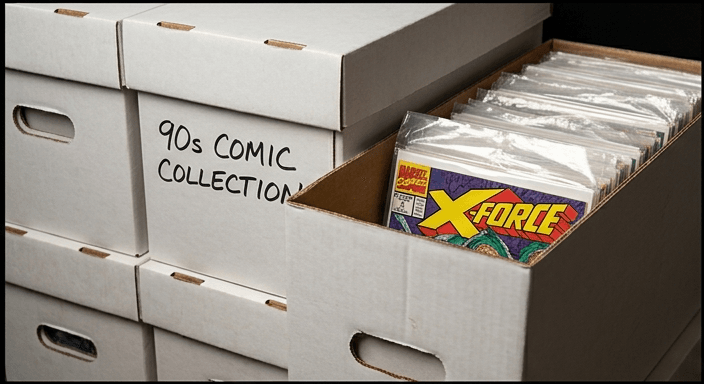
Not with the keys. When I find one it’s almost never with the keys. It’s in a short box of cartoon tie-ins someone bought for their kid, mixed with the rest of the animated-series run and whatever else came home from the grocery store in 1993. Nine times out of ten the copy is well-read, because these were bought to be read by children. That’s the bad news and the map: check the kids’ boxes, the tie-ins, the stack that never got bags. The same logic found a generation of New Mutants #98s hiding in the middle of unloved runs.
While you’re in that box: the rest of the run
If you found a #12, don’t stop there. The book most worth checking for next is The Batman Adventures: Mad Love, the 1994 one-shot by Harley’s creators, Paul Dini and Bruce Timm, that tells her origin story. It’s an award-winning book that collectors seek out in its own right, and it lived in exactly the same kids’ boxes. It trades below #12, but it’s a real book, and the two together are a better phone call than either alone.
The rest of the animated-line run is mostly modest: well-loved, widely printed enough, and priced accordingly. But Harley’s early comic appearances in the series carry premiums, and cartoon tie-in boxes from the same era sometimes hide other first appearances filed under “kids’ stuff.” The general rule from the valuation guide applies: check runs in order, because the covers won’t tell you which issue matters.
Quick answers
Is Batman Adventures #12 really Harley Quinn’s first appearance?
Her first appearance in comics, yes, in September 1993. Her actual debut was on the animated series in 1992, which is why listings say “first comic appearance.” The market treats #12 as the key either way.
My copy is worn. Did the kids ruin it?
They lowered it; they didn’t ruin it. Demand for this character is deep, and readable copies of #12 sell steadily at every grade, for the same reason a damaged key is still worth selling. It’s the sharp copies that carry the dramatic numbers, but a worn original beats no original.
What about the facsimile edition and reprints?
Worth far less than the original printing, but not nothing. The character carries even the reprints along. Check the indicia, price it as what it is, and don’t let anyone sell you a reprint at first-printing money either.
Should I just sell it on eBay myself?
For one sharp, correctly identified copy, maybe. If you have the patience for photographing, listing, shipping and the return window, you’ll gross more there. The honest tradeoffs are laid out in what buyers actually pay. Where I earn my keep is certainty and speed: I confirm the printing and edition in hand, pay cash the same visit, and you’re done. Pick whichever of those matters more to you. Both are legitimate answers.
Do you buy DC books? Your site is a lot of Marvel.
I buy comics, full stop: DC, Marvel, independents, whatever’s in the boxes. This book is on my want list for the same reason the Marvel keys are: people are looking for it, and it’s exactly the kind of book that turns up in a box nobody thought was worth checking. If one’s in your boxes, (951) 515-9604.
Keep going through the boxes
- Are 90s comic books worth anything? covers the decade this book escaped from, and the other exceptions.
- New Mutants #98: what the first Deadpool is worth is this book’s Marvel twin, hiding in different boxes.
- What happens on a free appraisal helps if the kids’ box turns out to have more in it than you thought.